
Fit Into Your Inference Stack
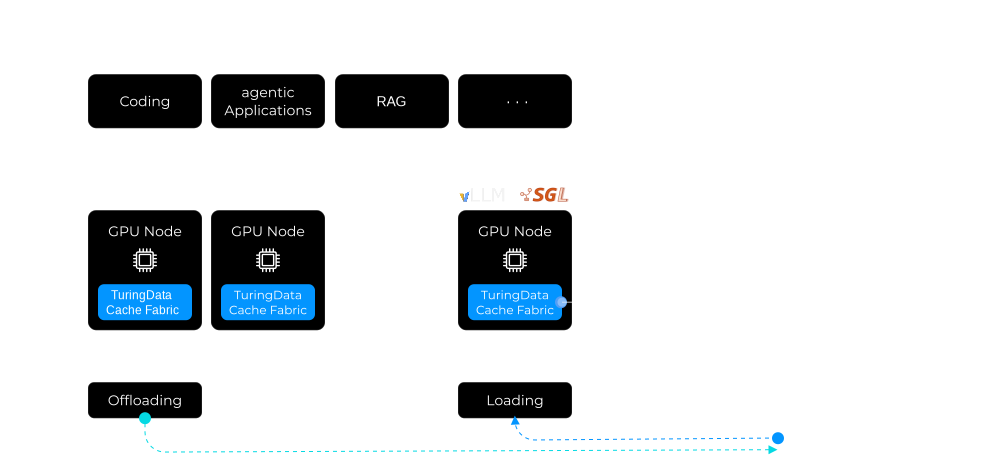
Cache Fabric integrates with vLLM and SGLang through a KV cache connector on the GPU server. ContextCube connects to Cache Fabric and compatible KV cache software, giving you options as your inference stack evolves.
Keep reusable KV cache available beyond GPU memory and across inference nodes. TuringData Cache Fabric orchestrates cache on your GPU servers. ContextCube adds a shared pool, helping reduce repeated prefill work so GPUs can spend more time generating tokens.
When an LLM reads a prompt, it computes attention keys and values known as the KV cache. A later request with a matching prefix can reuse that work instead of computing it again. The opportunity grows with long prompts and repeated context, but only while the cache remains available.
Long prompts and concurrent requests consume GPU memory. When reusable KV cache is evicted, the next matching request must rebuild it. Keeping cache in host DRAM and local NVMe creates more room for reuse beyond GPU HBM.
A request may arrive on a different inference node from the one that computed its context. A cache that stays local can leave useful work out of reach. A shared pool makes matching cached prefixes available to participating nodes.
KV Cache Solutions for Your GPU Servers and Your Cluster
Cache Fabric manages the cache hierarchy on each GPU server. ContextCube extends that hierarchy with a shared Tier 3.5 pool across the cluster. Start with the resources inside your GPU servers. Add shared cache capacity when reusable context needs to move beyond a single node.
In a controlled long context benchmark, Cache Fabric reduced repeated prefill work and increased throughput on the same GPU server.
Keep reusable KV cache available, retrieve matching prefixes and reduce the GPU work spent rebuilding familiar context.
Cache Fabric integrates with vLLM and SGLang through a KV cache connector on the GPU server. ContextCube connects to Cache Fabric and compatible KV cache software, giving you options as your inference stack evolves.

Cache Fabric manages KV blocks across GPU HBM, DRAM and local NVMe. Begin with available resources on your GPU servers and keep reusable context beyond the limits of GPU memory.

Add ContextCube to give participating nodes access to a shared KV cache pool. A matching prefix computed on one server can be retrieved by another, reducing repeated work when requests move across the cluster.

When a cached prefix matches, the inference engine can load its KV and compute the new suffix. Less repeated prefill work can shorten time to first token and leave more GPU capacity for generation.

Start with one ContextCube appliance and add appliances as shared cache needs grow. Size the pool for your model, context lengths, concurrency and latency targets, with KV transfer over RDMA.
TuringData’s AI inference solution seamlessly integrates with major LLM inference frameworks, requires no extra hardware, extends GPU memory, and boosts GPU utilization by letting LLMs reuse precomputed key-value pairs on the fly—dramatically accelerating token generation and reducing costs.
Download the White PaperExplore the shared Tier 3.5 design, appliance features and deployment considerations for reusing context across participating GPU nodes.
Explore ContextCube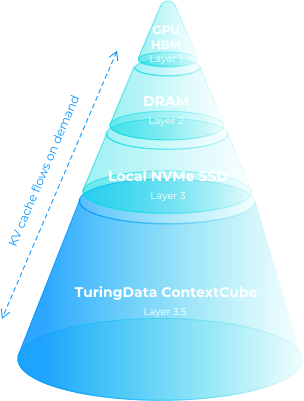
Yes. TuringData Cache Fabric can begin on a GPU server using available host DRAM and local NVMe. Add ContextCube when you need a dedicated shared pool across participating inference nodes.
Cache Fabric can run with local cache tiers. ContextCube provides a shared tier and connects to Cache Fabric or other compatible KV cache software, including LMCache and Mooncake.
It removes prefill work for the matching cached prefix. The engine still computes any new suffix. Requests without a matching available prefix need to compute their context.
Sizing depends on model characteristics, context lengths, concurrency, cache reuse and network bandwidth. Start with your latency and throughput targets, then validate the configuration on your own workload.
ContextCube is a shared KV cache appliance. It complements cache aware routing; your inference engine and orchestration software continue to handle model execution and request management.
Book a free 30 minute architecture review to explore Cache Fabric on your GPU servers and ContextCube across your inference cluster. Bring your model, context lengths, concurrency goals and latency targets so we can discuss a configuration and workload evaluation.