KV Cache Orchestration and Local Resource Management
Higher Token Throughput More Value from Your GPUs
TuringData Cache Fabric is software that reuses computed context to reduce repeated processing, accelerate responses, and help your GPUs serve more tokens.
As requests grow and context gets longer, GPUs spend valuable time processing information they have already seen. When that computed context cannot be retained and reused, users wait longer and each GPU has less capacity for new requests.
GPU Memory Fills Up
Limited GPU memory forces useful KV cache out. Without a retained copy, the same context must be computed again when it is needed.
GPU HBMActive KV
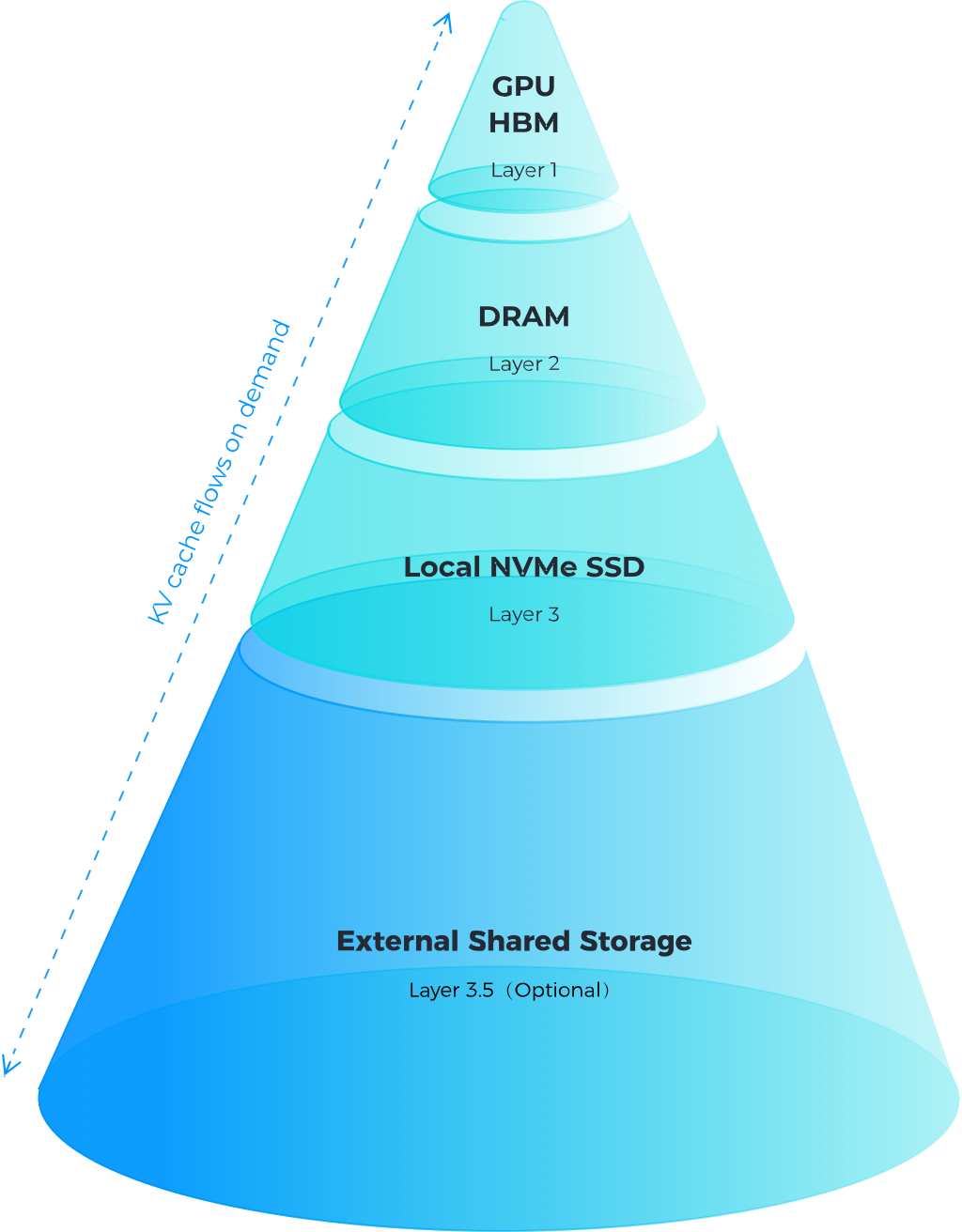
DRAMLocal NVMe SSD
Local Retention
Shared KV Pool
Retaining KV in DRAM and local NVMe can avoid recomputation when GPU memory is full.
Context Delays Become User Delays
When input processing and token generation run on separate servers, moving computed context can add to the wait for a response.
Prefill
Process the Input
Decode
Generate Tokens
KV
Interconnect or Network
The server generating a response needs the relevant KV before it can proceed.
Stored Context Can Still Go Unused
Keeping more KV is only part of the answer. The right cached prefix must be available and matched to the next request to avoid repeated processing.
RetainUseful Context
MatchThe Request
ReuseComputed KV
Reuse depends on a matching token prefix and compatible model and cache settings.
More GPU spend does not address repeated work by itself.
TuringData Cache Fabric connects to your inference engine and coordinates KV movement across local memory and storage. Here is how a computed prefix becomes reusable context.
01
Retain Computed KV
Keep active KV in GPU HBM and offload reusable blocks to DRAM and local NVMe SSD, extending retention beyond GPU memory.
02
Match the Request Prefix
When a request arrives, identify the matching prefix whose KV is available under compatible model and cache settings.
03
Retrieve KV and Generate
Load matching KV into GPU memory. The engine processes the remaining prompt tokens and generates the response, reducing repeated prefill.
Better Inference Economics
Serve More Demand. Deliver Faster Responses
Reduce repeated processing so more GPU capacity is available to serve users and generate tokens. TuringData Cache Fabric helps turn context reuse into better serving performance.
01 / Higher Concurrency
Serve More Users at Once
Reduce competition between repeated input processing and active requests. Create headroom for more concurrent sessions on your existing GPUs.
02 / Higher Token Throughput
Get More Output from Your GPUs
Reuse matching context so GPUs spend less time repeating work and more time generating tokens. Increase serving capacity from the hardware you already operate.
03 / Faster Inference
Keep AI Experiences Responsive
Shorten the wait for the first token and reduce contention during generation. Give users faster responses as conversations and context grow.
Measured on One GPU Server
Same Hardware. More Inference
With DRAM and local NVMe enabled, TuringData Cache Fabric reduced repeated prefill and improved serving performance.
From Prompt to First Token
Median TTFT · Lower Is Better
vLLM recompute baseline
36.70s
vLLM + TuringData Cache Fabric
2.10s
Up to
94%
Lower median time to first token
Up to
92%
Lower median time per output token
Up to
11x
Total token throughput
Input + output tokens
TuringData white paper, 2026. One node with 8 NVIDIA H200 GPUs; GLM-5.2-FP8; vLLM 0.23.0; 128 GiB DRAM cache and local NVMe; GuideLLM 0.7.3. Repeated synthetic prefixes, compared with the paper’s vLLM recompute baseline. Figures shown summarize the measured 100K-context result.
Agents, coding assistants, and token factories bring longer context and repeated calls to your serving stack. Make KV cache reuse part of infrastructure planning, so growing AI demand can translate into more useful inference from each GPU.
Deploy on the GPU Servers You Have
TuringData Cache Fabric runs as containerized software alongside your inference engine. Use local DRAM and NVMe capacity to start reusing KV without a separate cache appliance.
Improve Your Cost per Token
Get more inference from each GPU by reducing repeated processing. Higher serving throughput can spread infrastructure costs across more tokens and help make expansion more cost-effective.
Validate First, Then Expand
Start on one GPU node, measure the gains on your workload, and use those results to guide a wider rollout. Scale the software as your serving fleet grows.
The Setup, Results & ProofThe Setup, Results and Proof
A performance validation of TuringData Cache Fabric with vLLM and GLM-5.2-FP8. See how local KV reuse performed across 16K–100K input contexts and 18 operating points.
Test environment and reproducible methodology
First-token latency, token generation, and throughput
Complete results across context lengths and concurrency