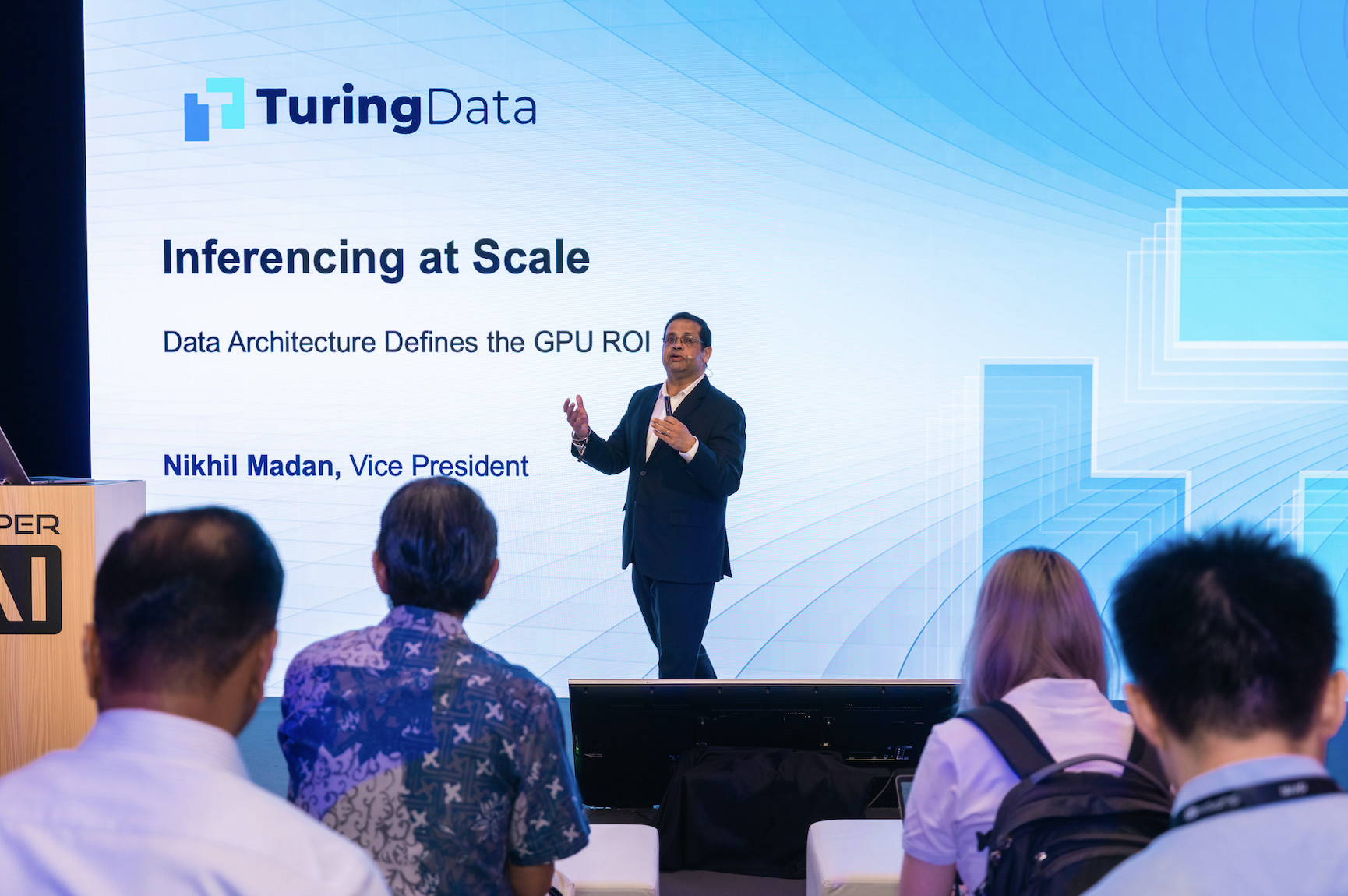
At SuperAI 2026, one of Asia’s largest AI conferences, TuringData Vice President Nikhil Madan delivered a presentation highlighting the rapid shift in the economics of AI infrastructure—from raw GPU capacity toward token production efficiency.
As enterprises and AI service providers race to deploy large-scale AI applications, the industry is entering a new phase where the key metric is no longer the number of GPUs deployed, but the volume of tokens generated efficiently and profitably.
“We are no longer operating GPU clusters—we are operating token factories,” said Madan. “The organizations that win in the AI era will be the ones that maximize token throughput while minimizing infrastructure waste.”
The Token Explosion Is Already Here
AI tokens are the fundamental units used by large language models to process, reason, and generate outputs. They directly determine both the computational workload and the cost of AI applications and infrastructure.
Over the past 16 months, global AI token consumption has increased dramatically, driven by the rapid adoption of Agentic AI systems, sovereign AI initiatives, and large-scale enterprise deployments.
Unlike traditional chatbot interactions, Agentic AI workflows run continuously and autonomously. These systems rely on multi-step reasoning, orchestration across tools and models, and persistent execution loops—resulting in significantly higher token generation compared to conversational AI. This evolution is placing unprecedented demand on AI infrastructure at scale.
At the same time, this shift is also translating into substantial cost pressure for enterprises deploying AI in production environments, with token consumption becoming a major driver of infrastructure expenditure."
We are no longer debating whether AI will scale," Madan noted. "It already has. The question now is whether your infrastructure can keep up with the economics of that scale."
The Hidden Bottleneck: AI Memory and the GPU HBM Tax
While industry attention remains focused on GPUs, TuringData highlighted a growing challenge in AI inference infrastructure: the performance limitations of KV Cache management.
KV Cache is the memory mechanism that stores intermediate attention states during LLM inference, allowing the model to reuse prior computations rather than reprocessing context from scratch. As context windows expand and agentic AI workloads grow more complex, efficient KV Cache management has become a critical determinant of inference performance.
LLM inference consists of two distinct phases: Prefill and Decode. The Decode phase is compute-bound — faster GPUs directly improve token throughput. The Prefill phase, however, is memory-bound, and its critical path runs through the KV Cache. As context lengths grow, KV Cache rapidly exhausts GPU HBM capacity — and once on-device memory is full, the system has nowhere to turn.
When storage cannot serve the overflow at the speed inference demands, GPUs are forced to recompute entire context windows from scratch — burning compute that enterprises have already paid for. Madan called this the "HBM Tax": organizations end up over-provisioning GPU clusters primarily to compensate for memory limitations that purpose-built storage could solve at a fraction of the cost.
Storage is no longer a passive repository. In modern AI systems, it has become the real-time feeding mechanism that determines how effectively GPUs can produce tokens.
A Software-Defined Approach to AI Data Infrastructure — TuringData Cache Fabric
To address these challenges, TuringData introduces Cache Fabric, a software-defined data infrastructure layer designed to optimize KV Cache management across distributed AI environments. Functioning as a unified, automated data factory platform, TuringData Cache Fabric operates with key operational mechanics:
- It deploys as pure software inside containers natively on existing GPU nodes.
- It offers fully configurable DRAM allocation and multi-layer cache orchestration across VRAM, DRAM, and local NVMe layers.
- It executes aggressive scheduler optimization to route KV Cache flows seamlessly on-demand.
- It allows immediate KV Cache reuse across distributed GPUs, continuously tracking key metrics.
Through these mechanisms, TuringData Cache Fabric helps organizations:
- Reduce Time-to-First-Token (TTFT)
- Improve GPU utilization
- Increase token throughput
- Scale AI infrastructure incrementally without significant hardware expansion
In benchmark evaluations using mainstream reasoning models, TuringData Cache Fabric demonstrated up to 10× improvement in Time-to-First-Token (TTFT) and up to 9× higher token throughput, primarily driven by improved KV Cache reuse efficiency and reduced memory access bottlenecks.
Token throughput is now a direct revenue lever. Every token generated is a billable unit. The higher your throughput on a fixed GPU configuration, the more revenue that infrastructure produces — without adding hardware. In the Token Economy Era, optimizing for token output per GPU is no longer just an engineering goal. It's a business imperative.
Enterprise AI Requires a Different Infrastructure Model
Madan emphasized that enterprise AI adoption follows a fundamentally different path than hyperscale cloud providers.
“Most enterprises do not start with hundreds of GPUs,” he said. “They start with a business problem, validate ROI, and then scale. What they need is infrastructure that can grow with them—not massive, complex architectures designed for hyperscalers.”
TuringData believes the next generation of AI infrastructure will prioritize flexibility, software-defined scalability, and efficient data movement rather than simply increasing compute capacity.
Looking Ahead
As inference becomes the dominant operational cost of AI, TuringData expects data architecture to play an increasingly critical role in determining AI profitability.
“The future of AI infrastructure will be defined by how intelligently organizations move, cache, and reuse data,” Madan concluded. “The conversation is shifting from GPUs alone to the economics of token production—and that is where the next wave of innovation will happen.”
About TuringData
TuringData is a full-stack AI storage company purpose-built for data-intensive AI workloads, delivering a lean architecture and high-performance data infrastructure without compromise. It enables enterprises across LLMs, autonomous driving, GPU clouds, and quantitative trading to get more out of every GPU — accelerating training, reducing inference latency, and increasing token throughput — while achieving industry-leading cost efficiency from core to cloud.